AI Framework for an Equitable World NTEN

A much-needed AI framework for a more equitable world

Since losing my job in a round of budget-cutting layoffs at MomsRising (where I spent 10 years building web sites, IT systems, security protocols, and trainings) I have been seeking a new opportunity to help a progressive organization or campaign to more effectively use technology in support of grassroots organizing for political change. One of the things I have found in every CTO and IT Director position I see is that everyone wants to use AI now, but not everyone is sure why or how.

I am so grateful to have received a scholarship to enroll in classes to earn NTEN’s AI for Nonprofits Professional Certificate. I have been following the discussion around AI safety and ethics for many years, including as MomsRising’s Senior Director of Internal Technology and Security. This certificate program is giving me more practical tools for how to create and guide AI applications that can serve movement organizing while still staying true to our progressive values like justice, equality, and mutual care.

This week, I took a class created by Amy Sample Ward and Tristan Penn about the AI Framework for an Equitable World that was created in a community process led by NTEN in 2023. I greatly appreciate this approach which shows how assessment and impact are essential, on-going elements of any AI intervention. Below is a diagram of the framework. This is exactly the type of useful resource that I and any nonprofit IT leader can use to develop tools and processes that are both more effective and less harmful. I look forward to putting this into use soon!
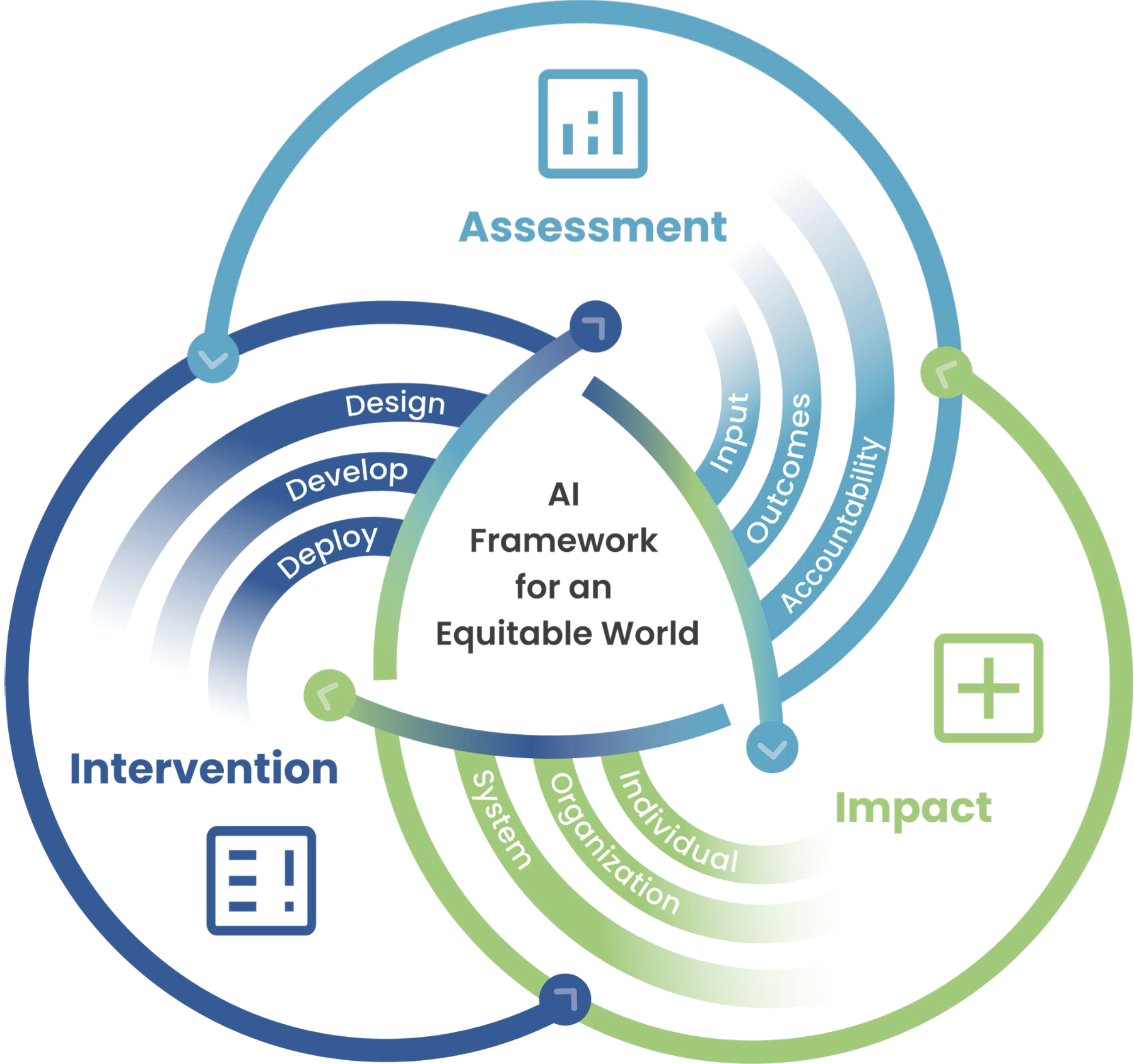
AI Framework for an Equitable World. 

A diagram with 3 connected loops. 

Assessment: Input, outcomes, accountability 

Impact: Individual, organization, system 

Intervention: Design, develop, deploy

Learn more and download the full report at https://www.nten.org/posts/publication/artificial-intelligence-framework-for-an-equitable-world
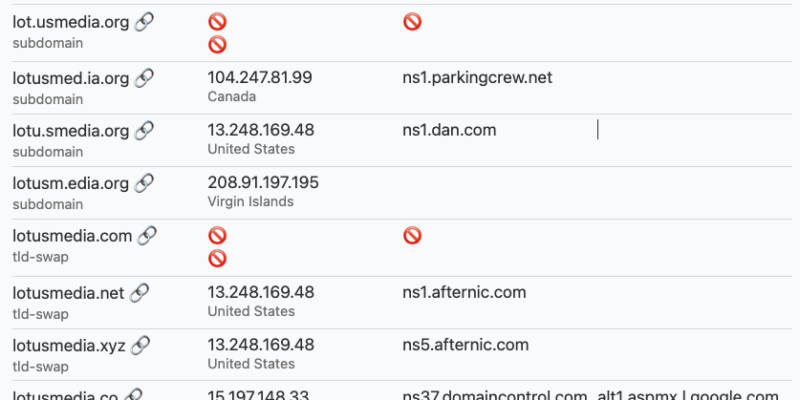

screenshot of 15 domains that are spoofs of lotusmedia.org

An easy way to reduce the ability of scammers to spoof your domain

I recently participated in NTEN‘s new cybersecurity community, and learned about this wonderful easy tool called DNStwist. All you have to do is enter your own domain name (eg: lotusmedia.org in my case) and it scans global domain registries for common variations designed to trick a reader into thinking it’s your domain.

A very common phishing technique is to send an e-mail seeming to be from your organization that sends people to what seems like your website. Both the e-mail address and URL might look almost exactly like yours, especially to someone who is not paying attention. Often scammers will add an element of urgency which adds to the user’s confusion and lead them to take action before thinking it through clearly.

After running this scan which shows 15 domains spoofing mine, my next step as an organization would be to block all of these addresses from e-mailing anyone in my workspace. Unfortunately I don’t have any way to stop an external internet user from visiting and mistaking one of these sites for mine. So be alert and make sure you always know who is behind what you’re looking at!

Continue reading “An easy way to reduce the ability of scammers to spoof your domain”
Drupal 8

Getting started with Drupal

Last week I attended the Nonprofit Technology Conference for the first time since 2011. I was very impressed with the organization and the the content of the conference, it was great to see how the community has evolved over the years.

Along with Tim Nafziger, I co-facilitated a discussion session for members of the NTEN/Nonprofit Drupal community. We had an excellent group with a wide range of people participating, from newbies to agency owners. Our two main topics were how to get started learning to use Drupal, and what the future of Drupal holds. The latter topic is hard to summarize, but suffice to say there are still a wide range of opinions about Drupal 8. Even more than 2 years after it’s release, there are still 4 times as many sites using Drupal 7 as Drupal 8.

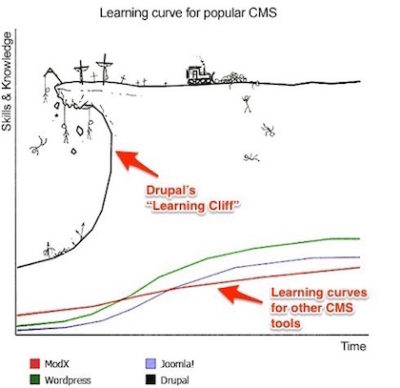
As for learning Drupal, we had many great suggestions. One person shared this cartoon illustrating that rather than the typical “learning curve,” figuring Drupal out is more like climbing a cliff. But when you get to the top you can really kick butt.

The Drupal Learning Cliff


So, here are our suggestions for scaling that cliff!

How to think like a network… on fire

As I mentioned last month, I gave a 5-minute Ignite talk called “”How to think like a network (a.k.a. Five aspects of effective networks in five minutes)” at the 2011 Nonprofit Technology Conference. It’s the latest version of my ongoing rant/spiel about network-centric advocacy. Below is a video of my talk with the actual slides underneath so that you can follow along at home. Think you can keep up?

(Apologies for how Slideshare mangles the design of the slides!)

Building “buzz” for your cause

WeAreMediaToday I’m thrilled to be at the annual conference for North Carolina nonprofits. This used to be a regular hangout for me, but in the last decade my work has shifted to more national organizations and I haven’t had the time or funding to attend it in many years. Nice to see all the new and old faces here.

The reason I’m here is that I was invited to be a co-presenter of NTEN’s We Are Media workshop. This all-day workshop is based on the fantastic curriculm developed by the NPtech community with Beth Kanter’s leadership a few years ago. For my breakout session on “Building Buzz” I’ve combined NTEN’s materials on the subject with my own network-centric approach. You can see the results in my presentation…

Five aspects of effective networks

I’ve been doing a few presentations lately that include the basics of network-centric organizing, so I thought it would be helpful to post a refresher here. With props, as always, to Marty Kearns from whom I learned a lot of this.

Update 6/25/10: Here’s the latest version of my presentation on network-centric thinking: https://lotusmedia.org/how-to-keep-thinking-like-a-network

Update 5/22/08: Now you can watch the presentation, which makes very little sense without me talking.

Five aspects of effective networks

  1. Strong social ties
    • Personal relationships
    • Trust
    • Awareness
  2. Dense communication grid
    • Online & offline
    • One-to-one, one-to-many, and many-to-many
    • For example
      • Blogs, forums
      • E-mail, IM, SMS
      • Face-to-face
  3. Common story
    • Shared values
    • Collective narrative
  4. Culture of sharing
    • For example
      • Data, information
      • Skills & expertise
      • Money
      • Space
  5. Network awareness
    • Feeling like a member
    • Knowing what the network is for

Here are some more resources to learn more about network-centric organizing strategies:

  • Earlier presentations on this topic: https://lotusmedia.org/advocacy-20-the-slideshow (slides) & https://lotusmedia.org/ruby-goes-to-class (video) &
    https://lotusmedia.org/civic-engagement-and-technology (with helpful links)
  • Blogging tips: https://lotusmedia.org/so-you-wanna-start-an-advocacy-blog
  • Network-centric approach to politics: https://lotusmedia.org/the-political-cluetrain
  • Background reading: https://lotusmedia.org/network-centric-reading-list
  • Marty Kearns’ widsom: http://advocacy20.org & http://netcentriccampaigns.org

… and more in my “Advocacy 2.0” category on this blog: https://lotusmedia.org/in/nptech/advocacy/

Welcome to the Lower Ninth Ward

Last week, Brian and I had the immense pleasure of being given a post-Katrina tour with Quintus Jett, a professor at Dartmouth. He is the Director of the Gentilly Project, an effort to use open source principles to map the state of storm-damaged New Orleans neighborhoods. At their web site you can use dynamic GIS maps to zoom in on the condition of each lot (ie: vacant, being renovated, occupied, etc.), and zoom out to see the block-by-clock process of rebuilding.

I was so grateful for a chance to see the community personally. As you may know, there are still spray-painted symbols on many homes left by the rescue efforts. The biggest shock was that much of the Lower 9th Ward, which used to be hundreds of homes, is now a grassy field with just a few cement blocks and slabs marking former foundations.

You can browse my pictures at Flickr or watch the slideshow below.

NTC on Twitter

I tweeted at the Nonprofit Technology Conference last year, but not many people were even aware of Twitter then. This year, way more folks are tweeting. We are having great conversations. Plus you can follow the #08ntc hashtag and see it collected even if you don’t follow each person who is tweeting the conference.

Kudos to Holly Ross and the NTEN posse for the best NTC yet! (Of course, I still have a few suggestions… 😉 )

Big NPtech news

Seven months ago, I lamented about Convio buying GetActive, now Convio’s going public. I call this more bad news for nonprofits.

However, our day is also brightened by the news that the lovely and (extremely) talented Holly Ross is taking the helm at NTEN. She has ably and patiently run their Nonprofit Technology Conferences for many years and is a great choice to continue to lead NTEN. Congrats, Holly.

It must be noted that I bitched about the fact that the last time they hired a new ED (14 months ago) I only got an e-mail from NTEN and had no blog entry to link to. This time, that is certainly not the case. Well done, all.

Also, good luck to my friend and outgoing ED Katrin Verclas, who will surely find success in whatever she does. I hope it’s kicking butt with MobileActive.

Mind the gap, part 1

This is the first part of a rant I have been mulling over for about 3 years now. I want to get it up before the end of the event, so I will save my proposal for a second post. Cross-posted at http://www.netsquared.org/blog/rubyji/mind-gap-part-1

Advanced nonprofit technology practitioners need a place to connect and learn from each other. Who will fill this gap?

For years this was the collective whine from the hundreds of NTAPs who attend the Nonprofit Technology Conference to help other colleagues in the sector. When NetSquared was announced in 2005, I was excited to hear they would be bringing together the best minds from the nonprofit world with the leading technologists. Would this be the long-awaited venue for advanced “NPTECH” conversation?

In 2006, I attended NetSquared and it was one of the most useful and impactful conferences I had been to in years. (See my blog post here.) I eagerly signed up to come and participate again this year.

As you know if you are reading this, N2Y2 has a different goal, which is to connect innovative projects with the funding they need to succeed. I question whether $25,000 is enough to really make much impact, but I appreciate that this is a good goal. But it’s one that I don’t have any personal investment in, and it leaves the need for interaction largely unmet.

Tune in for Part Two: Eating our own dogfood, and meeting our own needs. To be posted here and at http://www.netsquared.org/blog/rubyji