A sepia tone of what seems to a young Black girl with her eyes covered by a black rectangle (censor style) with white letters reading "Don't Believe The Hype (remix)"

Beware the AI Hype Cycle

In the months I been seeking my next job in nonprofit tech, I’ve learned that the sector is quite invested in using AI right now. There are so many important applications of LLMs and machine learning, in fact we’ve all been using it for years to do things like sorting our inboxes, analyzing complex data, finding the perfect digital asset for a specific purpose, and showing the perfect next video for our interests. I don’t want to give those things up. (OK, maybe that last one sometimes.)

Frankly, I worry that seeming critical of AI will negatively impact my employment prospects, but there’s a reason that I have a reputation as a trustworthy and ethical tech leader. And I hope that there are still organizations that would rather have an honest technologist instead of one that never challenges them. There are real benefits but we have to tell the truth about the fact that there are also real harms to our organizations, our communities, and our planet from reliance on AI.

I suspect the current normalization of generative AI as simply part of how we all work now is much more based in marketing hype than practical nonprofit sector experience. I learned about the AI hype cycle from researchers like Timnit Gebru and Emily Bender. I’ve been following them since 2021 when Gebru and others were fired from Google’s AI ethics team when their bosses objected to their groundbreaking co-authored paper on LLMs called “On the Dangers of Stochastic Parrots: Can Language Models Be Too Big? 🦜“.

The adoption that big tech wants us to believe is “inevitable” is much more driven by the fact that companies are cramming it in to every piece of software whether users want them to not. Business experts have made it clear that Big Tech is over leveraged in the AI sector. If we don’t use it enough, they don’t make the profit they need. We don’t need AI to survive as much as it needs us to live.

In their latest article, Bender and Gebru once again bring us back down to earth:

The AI industry has even suggested that popular, bipartisan anti-data-center activism is a “distraction” from attempts to regulate the impending, scary, “superhuman” machines these companies are building. According to the AI industry, we should be more worried about a fictional machine god than about the climate catastrophe that these data centers exacerbate, the asthma suffered by those living near them, the rising electricity bills of the public subsidizing them, or the water that is redirected to cooling them.

– Don’t be fooled by this summer of AI hype, 9/22/26

As nonprofits and community-oriented people continue to learn and experiment with AI, it’s essential that we stay focused on the real requirements of our missions and the real consequences of our choices. As Flava Flav taught us, don’t believe the hype!

A closeup of art that has tiny mirrors with circles cut out woven into a chainlink fence

A human starts the loop, a human can stop it

In the social good side of the tech world (hashtag nptech), I hear people and institutions talk about the necessity of having “a human in the loop” when working with AI. This usually means that a responsible person reviews output from an LLM before it gets out in the wild. This is a low standard, but it’s not wrong. I hope to see more discussion of what having a human in the loop means for agentic AI, which is generally sold to us as a way to reduce human labor (for better or worse).

But let’s be serious. Humans need to be more than “in the loop.” Humans need to be held accountable for the results of their actions. Software does not build itself. Agents do not tell themselves when to run. When we talk about these tools as if they “went rogue” and “hacked into” things, we are removing the humans that built the tool, configured the sandbox, and gave the instructions.

AI is not people (nor are corporations but that’s another rant). As written in a 1979 IBM training manual, “A computer can never be held accountable, therefore a computer must never make a management decision.”

Software can’t be bound by the law, but its creators can and they must.

AI Framework for an Equitable World NTEN

A much-needed AI framework for a more equitable world

Since losing my job in a round of budget-cutting layoffs at MomsRising (where I spent 10 years building web sites, IT systems, security protocols, and trainings) I have been seeking a new opportunity to help a progressive organization or campaign to more effectively use technology in support of grassroots organizing for political change. One of the things I have found in every CTO and IT Director position I see is that everyone wants to use AI now, but not everyone is sure why or how.

I am so grateful to have received a scholarship to enroll in classes to earn NTEN’s AI for Nonprofits Professional Certificate. I have been following the discussion around AI safety and ethics for many years, including as MomsRising’s Senior Director of Internal Technology and Security. This certificate program is giving me more practical tools for how to create and guide AI applications that can serve movement organizing while still staying true to our progressive values like justice, equality, and mutual care.

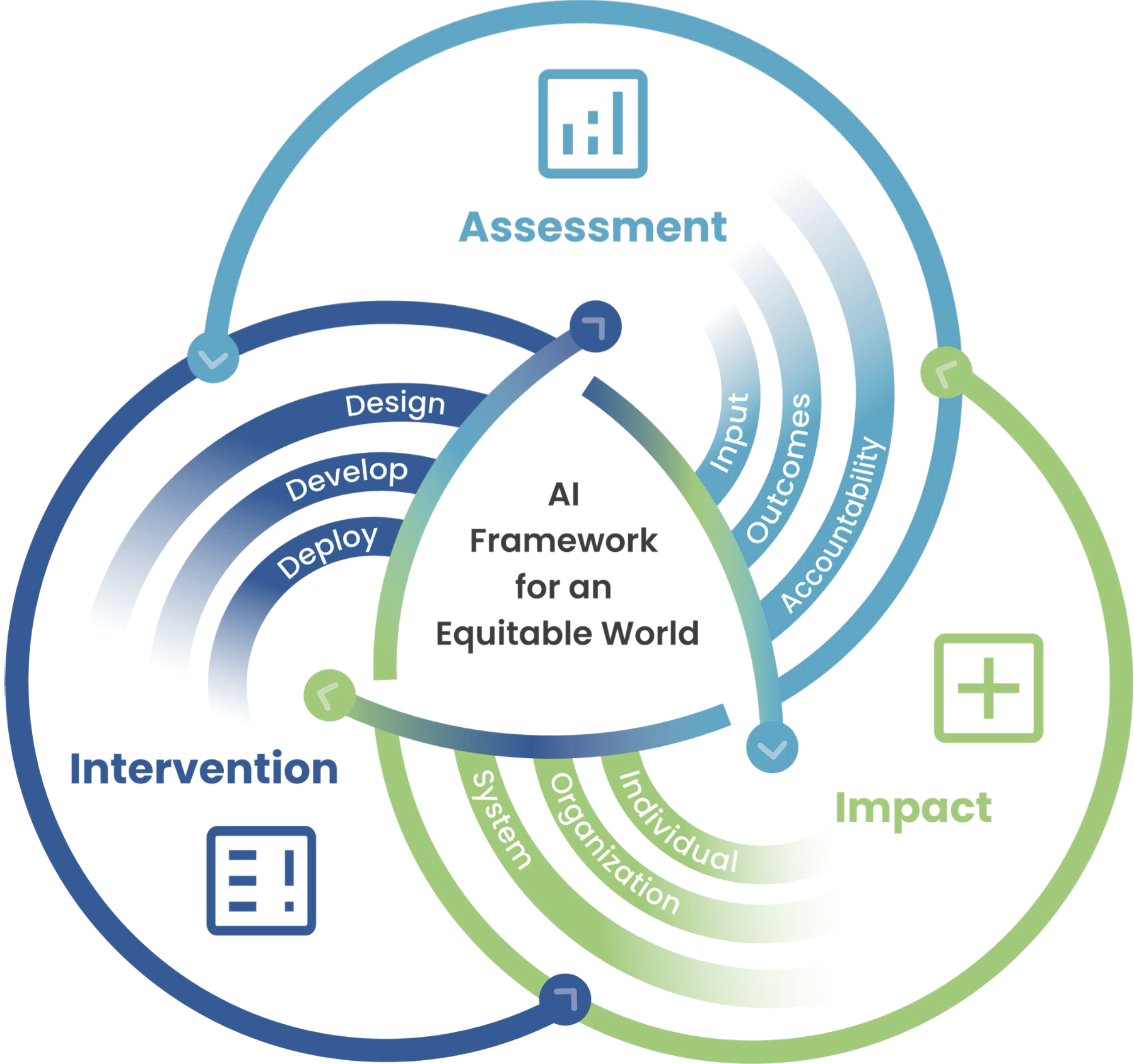
This week, I took a class created by Amy Sample Ward and Tristan Penn about the AI Framework for an Equitable World that was created in a community process led by NTEN in 2023. I greatly appreciate this approach which shows how assessment and impact are essential, on-going elements of any AI intervention. Below is a diagram of the framework. This is exactly the type of useful resource that I and any nonprofit IT leader can use to develop tools and processes that are both more effective and less harmful. I look forward to putting this into use soon!

AI Framework for an Equitable World. 

A diagram with 3 connected loops. 

Assessment: Input, outcomes, accountability 

Impact: Individual, organization, system 

Intervention: Design, develop, deploy

Learn more and download the full report at https://www.nten.org/posts/publication/artificial-intelligence-framework-for-an-equitable-world

Screenshot of a YouTube video which shows Ronald Reagan wearing a plaid shirt and reading from a paper into two microphones

Republicans reap ‘The Liar’s Dividend’ thanks to AI and corporate journalism

Parker Molloy has a great new essay on Trump’s repeated subversion of reality, seen recently in his claim that Ronald Reagan loved tariffs when in fact he hated them as accurately portrayed in this Canadian ad with unadulterated clips of him speaking. This reminded me of the often-quoted Hannah Arendt, who I really need to read much more of.

“If the public loses faith in what they hear and see and truth becomes a matter of opinion, then power flows to those whose opinions are most prominent — empowering authorities along the way.”
– The Liar’s Dividend: Trump, AI, and the Death of Shared Reality by Parker Molloy, Oct 28, 2025

“In an ever-changing, incomprehensible world the masses had reached the point where they would, at the same time, believe everything and nothing, think that everything was possible and that nothing was true. … The totalitarian mass leaders based their propaganda on the correct psychological assumption that, under such conditions, one could make people believe the most fantastic statements one day, and trust that if the next day they were given irrefutable proof of their falsehood, they would take refuge in cynicism; instead of deserting the leaders who had lied to them, they would protest that they had known all along that the statement was a lie and would admire the leaders for their superior tactical cleverness.”
– The Origins of Totalitarianism by Hannah Arendt, 1951

screenshot from native-land.ca showing many overlapping territiries

Land acknowledgement

For years I have relied on the maps at native-land.ca to help me understand the history of the land I am on. Today I discovered it has an AI tool called KĹŤrero that you can converse with to create a personalized land acknowledgement statement.

Below is the statement it created with my input. I love it!

With gratitude, I reflect on my lifelong connection to this land—home to the Lumbee, Skaruhreh/Tuscarora, Cheraw, Mánu: Yį Įsuwą (Catawba), Saponi, Occaneechi, Eno, and Shakori peoples, whose care for these waters and forests sustains us still. As someone who walks the banks of the Eno, I commit to honoring their legacy by protecting this river, supporting my neighbors, and tending to the land as a humble participant in its story. Let my actions—from mutual aid to mindful stewardship—be a small continuation of the care that has shaped this place for millennia.