Thank you, Elizabeth
Here’s a post I recently published on my local politics blog about Elizabeth Edwards…
Elizabeth Edwards passed away this week and is being warmly remembered from all corners. Many people talk about her great heart and the strength of her resilience, and it’s true that she was an incredible model for anyone dealing with personal pain.
But I remember her best for being whip smart and unbelievably charming. I met her once, and she was even more brilliant and impressive in person. Her death is a huge loss for Chapel Hill, for North Carolina, and for the whole country that has been a beneficiary of her health care activism in recent years.
For those who haven’t been reading OP forever, here’s the comment she posted here in 2005 after the Edwards’ moved to Orange County. And below is the text of a 2006 OP post called “Elizabeth Edwards, keeping it real.”
I swear Rosemary and I didn’t plan this, but I just read and wanted to post about this article by my friend Micah Sifry about Elizabeth Edwards. He says she is the “only person who I think we can genuinely say is participating in the blogosphere, as opposed to just using it.” One of his supporting examples is Eliabeth’s visit to OP to answer some questions I had raised about the location of their new home and the status of their voter registration.
As usual, she responded openly and directly. As I wrote to Micah, Elizabeth is so smart and fierce and charming it’s scary. Further proof was seen in her graceful handling of that clown Chris Matthews on live TV recently. I sometimes have complaints about her husband’s policies (the same I have of almost every Democrat), but as a person I only admire her more the more I get to know her. I wish nothing but the best to the entire Edwards family.
Thank you for sharing part of your life with us, Elizabeth. You made the world a better place by sharing yourself with us.
Happy Hanukkah, y’all!
Here’s some music to get you in the mood: http://www.last.fm/listen/globaltags/hanukkah

New media and the civil rights movement
Cross-posted at http://www.hastac.org/blogs/ruby-sinreich/new-media-and-movement
 Last week I had the immense pleasure of attending and participating in “The Unfinished Work”: Advancing New Strategies in the Struggle for Civil Rights a conference honoring civil rights pioneer Julius Chambers. The event was attended by several generations of leaders including many former staffers from the NAACPs Legal Defense Fund (one of the main litigators of civil rights cases). I was personally in awe of the intellectual and cultural prowess of Harvard Law Professor Lani Guinier and Bennett College President Julianne Malveaux, who laid out with precision and wit the problems inherent in the mere idea of a “post-racial” society, not to mention the fact that we most certainly are not living in one.
The Guinier-led plenary also featured Wade Henderson who is the President of the The Leadership Conference on Civil and Human Rights. He spoke of the decline of the old ways that people used to get information, and the rise of personal networking tools such as Twitter and Facebook. His point that the civil rights movement needs to evolve along with this shifting media ecosystem or risk extinction was a perfect lead in for the panel I was invited to moderate on “New Media and Messaging Social Justice for Social Justice Advocates.”
This distinguished panel brought together insights from a wide range of organizations and issues into a cohesive message which was summarized by panelist Keith Kamisugi: online shouldn’t be your only strategy, but without online you have no strategy. If possible, I will add a recording of the panel when it becomes available. I’ll attempt to summarize our three key topics here:
Lynda Turet of the Center for Social Inclusion began by sharing the CSI’s work researching how people respond to discussion of issues with and without racial symbols. They found that people actually responded better to an ad about health care reform when it specifically addressed the racial undertones that come along with the issue (for many white people) than a similar ad that ignored race. This prompted me to mention Berkeley Professor George Lakoff‘s 2004 book Don’t Think of an Elephant (a very accessible effort to bring cognitive linguistics to political activists). His main point is that all people have both liberal and conservative frames that we use to understand the world, and that successful activists should work to activate their own frame rather than attempting to negate (while actually reinforcing) their opponent’s view.
Next Jed Miller of Revenue Watch Institute drew on his experiences, including serving as the Internet Director for the ACLU and as an early online community builder for the New York Times, to lay out three major principles for any organization hoping to be successful in the digital age. 1. Timing is critical to having a relevant message that anyone wants to hear. 2. You must understand and work with the network-centric nature of new media. (More on this subject from me.) 3. You must build new media capacity within your organization rather than rely on outside consultants.
Finally Keith Kamisugi of the Equal Justice Society talked about the Digital Divide and the importance of Net Neutrality to preserving free speech on the Internet. (He was also very gracious about the other two speakers running over into his time.)
We didn’t have as much time for questions as we would have liked, but there was some good conversation about information overload, and also a question about efficacy which prompted me to mention Malcom Gladwell’s recent New Yorker peice “Small Change” asserting that Internet activism is not true grassroots organizing and doesn’t really change anything. This thesis was thoroughly debunked by many parties including Cathy here on HASTAC.
Again, it was an honor for me just to participate in this conference with so many legal and movement heavyweights. I was inspired and educated by them, and was glad to have the opportunity to give back by moderating this panel of new media visionaries Lynda, Jed, and Keith. Thanks and kudos to the UNC Center for Civil Rights which organized The Unfinished Work. To learn more you can download a PDF of the program at http://www.law.unc.edu/documents/civilrights/conferences/the_unfinished_work_brochure.pdf
You need to know: The Powell Memo
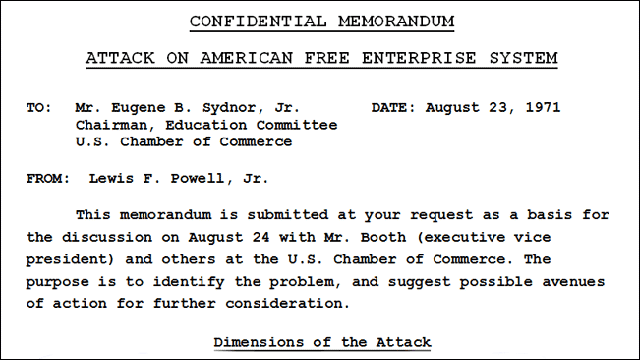
I was talking recently with a very learned and progressive scholar of history about the depth of the right wing’s messaging strategy, and he was unfamiliar with this document that helped create and define a broad and effective corporate-conservative machine: the Powell Memorandum. We all need to know this history.
From Wikipedia:
Based in part on his experiences as a corporate lawyer and as a representative for the tobacco industry with the Virginia legislature, [Lewis Franklin Powell, Jr.] wrote the Powell Memo to a friend at the U.S. Chamber of Commerce. The memo called for corporate America to become more aggressive in molding politics and law in the U.S. and may have sparked the formation of one or more influential right-wing think tanks.
In August 1971, prior to accepting Nixon’s request to become Associate Justice of Supreme Court, Lewis Powell had sent to the leadership of the U.S. Chamber of Commerce the “Confidential Memorandum”, better known as the Powell Memorandum, and still under the radar of general public. It sounded an alarm with its title, “Attack on the American Free Enterprise System.” The previous decade had seen the increasing regulation of many industries. Powell argued, “The most disquieting voices joining the chorus of criticism came from perfectly respectable elements of society: from the college campus, the pulpit, the media, the intellectual and literary journals, the arts and sciences, and from politicians.” In the memorandum, Powell advocated “constant surveillance” of textbook and television content, as well as a purge of left-wing elements.
In an extraordinary prefiguring of the social goals of business that would be felt over the next three decades, Powell set his main goal: changing how individuals and society think about the corporation, the government, the law, the culture, and the individual. Shaping public opinion on these topics became, and would remain, a major goal of business.
– http://en.wikipedia.org/wiki/Lewis_F._Powell,_Jr.#The_Powell_Memorandum
Farewell, Mehitabel
Last night a long feline life of 17 years came to a peaceful end as my friend Mehitabel sat in my lap and breathed her final breath. Here’s a short slideshow of photos of her:
Things I love about canvassing:
Meeting my neighbors and/or getting to know them better.
Enjoying lovely Fall weather.
Spending time with my son. (Now his second annual canvass.)
Checking out the variety of door styles and various porch architecture in my neighborhood.
Getting some exercise.
Beating Richard Burr!
Addressing Social Media Culture Shock
Since I already posted my slides from the NTEN We Are Media workshop held at the annual conference of the NC Center for Nonprofits, I thought I would post the slides from Kivi Leroux Miller‘s talk as well. I thought she did a great job of addressing the cultural and organizational change issues that many non-profits face when confronting new media and new forms of communication.
Addressing Social Media Culture Shock
View more presentations from Kivi Leroux Miller.
Enjoy!
In praise of…

(Things I’m feeling thankful for this morning.)
…saying what’s on my mind in more than 140 characters.
…family members who are fun to be around, have impeccable taste, take great care of my son, and make it possible to see each other more than once a year.
…awesome music on my headphones, like Mosadi Music which makes me smile and dance and learn.
…cheap coffee and free buses.
…the opportunity to see a wonderful dharma teacher like Therese Fitzgerald tonight.
Photo: http://dharmafriends.org/?page_id=251
Building “buzz” for your cause
 Today I’m thrilled to be at the annual conference for North Carolina nonprofits. This used to be a regular hangout for me, but in the last decade my work has shifted to more national organizations and I haven’t had the time or funding to attend it in many years. Nice to see all the new and old faces here.
The reason I’m here is that I was invited to be a co-presenter of NTEN’s We Are Media workshop. This all-day workshop is based on the fantastic curriculm developed by the NPtech community with Beth Kanter’s leadership a few years ago. For my breakout session on “Building Buzz” I’ve combined NTEN’s materials on the subject with my own network-centric approach. You can see the results in my presentation…
Building Buzz
View more presentations from Ruby Sinreich.