Woman on the Verge

image

Gazpacho

The weather hitting 100 degrees everyday this weekend and I can only think about cold food. So far I made ceviche, caprese salad, and gazpacho (pictured) which makes me want to watch Women on the Verge of a Nervous Breakdown again. http://imdb.com/rg/an_share/title/title/tt0095675/

My 2012 primary endorsements for Orange County, NC

Local politics can be difficult to follow, given the minimal media coverage and (fortunate) lack of political party involvement. Friends often ask me for my advice about how to vote in sleepy local elections such as this year’s Orange County Commissioners race. I can’t in good conscience endorse any of the incumbents. The current board seems to have invented a new form of government in which the staff sets policies, and then elected officials occasionally have misinformed or irrelevant discussions about them after the manager has already implemented his decision.

I strongly endorse Mark Dorosin and Penny Rich in District 1. Both will bring good ideas and real leadership to the Board of Orange County Commissioners. In District 2, I support Renee Price who will be
a better advocate for progressive policies than the incumbent. If you live in Hillsborough or rural Orange County, you will also be selecting 3 school board members. I recommend giving a vote to Lawrence Sanders who will bring thoughtful enthusiasm to the job. And there can be no doubt that Valerie Foushee is the best choice for NC House in every way. I’m happy to say that The Independent Weekly agrees, and endorsed all of these candidates as well.

If you enjoy living in one of the most open-minded and forward-thinking counties in North Carolina, as I do, I hope you will join me in voting for these hard-working progressive leaders. And if you have your own ideas about who people should vote for, I hope you will join the conversation at orangepolitics.org/issue/elections/2012.

Ruby Sinreich
Chapel Hill

NCT4G: Doing more with less in 2012

They’re trying something new this year at the N.C. Tech for Good Conference. Last year, I helped facilitate the North Carolina nonprofit community’s first experiment with an unconference! It went pretty well, but many NCT4G attendees were not convinced to spend a second day on this strange new format – or maybe they just understandably didn’t want to work on a Saturday.

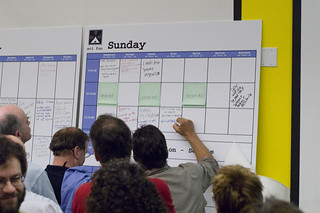
gridThis year, I have worked with the conference organizers to develop a hybrid format. I have seen hybrids work well, and I’ve seen them fail badly. I think we have come up with a structure that is truly the best of both worlds. This new approach gives us some reassurance in advance that there will be some great sessions to attend, but also allows the attendees to shape the event into whatever they want and need. Many participants don’t think of themselves as leaders but just as everyone has something to learn, everyone has something to share as well. This event allows all of us to do both.

So check out the schedule. Do you see something you’d like to learn? Do have an idea about what is missing? Add it on the wiki. Once we get the conference started, both the pre-selected speakers and the people thinking up emerging proposals will all have the opportunity to “pitch” or explain their session the participants and get added to “the grid.” What happens next is up to us! (For more about this process, see my blog posts from previous unconferences.)

Come on out May 4th – register by Friday the 27th to get the $75 early bird rate – and help us make this the event that you want and need!

NCt4G2012


Three is a magic number

3 I couldn’t write this post without the Schoolhouse Rock refrain in my head. Today is my son’s third birthday. We celebrated this weekend with a nice group of Izzy’s friends from school, and my friends with kids his age. The theme was Izzy loves trains, so we used the beer garden at Southern Rail, which is a restaurant that uses train cars and the old station in downtown Carrboro. Everyone had a great time, especially Izzy as you can see in Brian’s photo:

Help a busy, geeky mom choose a tablet

As you probably know, dear reader, I was an enthusiastic Mac user for about 20 years. Recently, open source software such as Ubuntu Linux and Mozilla Firefox have reached a much more accessible level and I have been happily only buying hardware that runs open source operating systems ever since. This includes my mobile phone (sort of) which runs the somewhat-open WebOS platform. (I bought it as a Palm loyalist, but then it was sold to Hewlett-Packard, who don’t seem to know what to do with it.)

Anyway, I’m telling you that to tell you this: For years when my friends drooled over iPads and and Android tablets, I was not moved. I bought a netbook that runs Ubuntu instead. But suddenly I find myself desperate for a tablet! What changed? A few things, including being a parent and seeing the many applications from ebooks for kids, to games and videos that can help entertain and maybe even teach my son. I’m also going on a long trip for work soon and want to do  a lot of reading. I do a lot of live-tweeting during meetings that I think I could do from a tablet if I had an external (probably bluetooth) keyboard. And a colleague recently mentioned that a lot of folks watch videos on their tablets while working out at the gym, which I could see me doing if I ever go ahead and get that membership.

So I have a lot of geeky friends, and I thought you might be able to help me decide on the best tablet for my needs. Some of the criteria I’m looking at:

  • Not made by Apple, and an open of an OS as possible. I like WebOS and so I’m open to the Touchpad as well as the many Android choices.
  • Preferably smaller than 10″ for ease of holding up for long periods, but this is not a deal-breaker.
  • SD or mini-SD slot so I can easily add music files.
  • Sturdy enough for a preschooler to play with it, or a large supply of compatible cases.
  • Bluetooth or some other method of connecting with an external keyboard.
  • Excellent full-featured web browser as almost everything I do is online.
  • Decent battery life.
  • Bonus: able to act as a remote control to my media center, which is a computer running Windows and Ubuntu.

Here are some of the leading contenders I’ve looked at recently.


Or Galaxy Tab 8.9

Bridging The On-Line Real-World Gap

As I was Googling for something from an old work project, I stumbled across this interview with Marshall Kirkpatrick from 2006. Marshall and I had met a few years before at the Nonprofit Technology Conference. He has gone on to become a leading blogger on new media issues and is now a Senior Writer at ReadWriteWeb. I’m pleased to say that I think what I said still makes sense over 5 years later, and I would give nearly the same advice today (in principle).

Bridging The On-Line Real-World Gap: An Interview With Ruby Sinreich Of Netcentric Campaigns

Ruby Sinreich is the Web Maven at Netcentric Campaigns, a division of Green Media Toolshed. She is also the founder and editor of OrangePolitics.org, a progressive multi-author blog about politics based in Chapel Hill, North Carolina. Previously, she was the Online Organizing Manager in the Public Policy Division of Planned Parenthood Federation of America.Ruby and I talked in the following interview about Netcentric Campaigns and building an effective on-line strategy to support off-line, real world political organizing.

Ruby:

Network-centric advocacy is based on a philosophy of empowering the grassroots, your supporters, the “network.” We try to build strong networks between activists so they collectively form an effective movement. There are five aspects that we think are necessary for effective social networks

  1. You must have strong social ties so that the members trust each other and know who (with what skills) is in the network. Friendster/MySpace/Orkut/etc. are one way to build social ties, but so are in-person gatherings. Happy hours can also build your movement.
  2. There needs to be a common story that ties members together. They should have a shared sense of what the problem or what the goal is. This can vary widely, it might be a generally shared value, or it might be a mutual bad guy.
  3. There has to be a dense communication grid so folks have many ways to meet and communicate with each other. Blogs and social networking tools are a part of this, so are instant messaging and face-to-face gatherings.
  4. The members should share resources with each other. This could be money, space, information, etc. Like a directory that members can access, or sharing expertise.
  5. Finally there should be a sense of purpose so the network members know what the network is for. So they think of it as a tools for collective action or whatever the goal is.

Marshall:

It seems that there has been work to bridge the online world and the offline world for progressive causes for at least a few years now. Are there specific lessons that have been learned that have changed the way that you now advise organizations to, for example, build strong social ties with online and off or build a common story?

Ruby:

I don’t really think much about the distinction between on- and off-line. When we know our goal and our strategy, that leads us to tools which may or may not be online. We want to use a lot of online social networking and self-publishing because it’s very supportive of the kind of ties we want to build.

The internet itself is very network-centric (at least right now) so it lends itself to organizing in this way.

Continue reading “Bridging The On-Line Real-World Gap” →

Stop censorship. Stop PIPA/SOPA.

A blog post I wrote for work at http://hastac.org/blogs/ruby-sinreich/2012/01/17/stop-censorship-stop-pipasopa 

HASTAC is joining with others around the U.S. and globally on the Internet to protest the outrageous SOPA/PIPA bill that – yes – is still making its way through Congress right now. Major organizations such Wikipedia,Mozilla, and many others are participating in a one-day black out, while others including Google, are using their home pages, as are we, to protest and inform about these frightening bills that would have a chilling impact on intellectual freedom and digital interaction. We were heartened by the news that the Obama administration is opposing the bills and so we chose to to stay online but with a banner on the site, but clearly the debate is far from over. The potential implications of this corporate and politically-motivated censorship upon academic freedom, especially digital scholarship, are simply staggering.

So many others have covered the issues around SOPA/PIPA so well (and my own understanding of the legislation is so comparatively tiny) that I won’t bother to rehash them but will link to some of the best below. Thanks to HASTACers Gerry Canavan for posting about SOPA last month and Alex Leavitt for today’s post about how SOPA opposition galvanized on Reddit. I highly recommend this 4-minute video that explains the legislation, including an important update at the end.

Link fest:


Guns over Franklin Street

I just sent the following letter to the Mayor and Town Council of Chapel Hill and cross-posted at orangepolitics.org/2011/11/guns-over-franklin

I was extremely disappointed to see the Town handle the anarchist break-in at the Yates Building so poorly after working so well with the activists at Occupy Chapel Hill/Carrboro for the past month. What happened last weekend played into every simplistic anarcho-fantasy about jack-booted thugs violently protecting the wealthy. That’s not the Chapel Hill we know, but there is a vocal group of residents that now may never believe otherwise.

I’m undecided about Jim Neal’s specific proposal for an independent commission to study the events of last weekend. Do we really have to empanel a committee to tell us what almost everyone knows (at least in retrospect), which is that the police action was unnecessarily forceful and overly broad? However, I very much want and need some clearer answers from the Town of Chapel Hill.

I understand that the police’s action was taken out of fear of violence, which was rationally based on the (limited) information they had at the time. But it was hardly the only tactic available to the Town. The range of options available could have included sending a plainclothes officer or civilian staffer to communicate with the group, possibly to negotiate or just to give them a deadline to leave. It’s not as if Riddle was being deprived of his non-use of the property, so there should have been time to consult the Mayor and maybe even other community leaders who would have provided valuable insight into the real risks involved (or not involved) before endangering the public by brandishing assault rifles on West Franklin Street and detaining people guilty of nothing but standing on a public sidewalk.

The people of Chapel Hill are owed an explanation and an obligation to try to avoid any further such actions. Below are my suggestions for how the Town can work to make amends and rebuild trust:

1. The Town Manager should investigate the chain of decision-making. Who gave the order, and was it consistent with instructions from the Chief and the Manager? I think so highly of both that I frankly have trouble believing they would have signed off on such an operation. I hope no-one has to be fired, but it’s critical that someone publicly admit that a mistake was made and take responsibility for it.

2. The Town should drop the charges against the squatters (or encouraging Riddle to drop charges, if he pursues them) as a goodwill gesture in response to the excessive use of force and intimidation during the arrests. This can be done while making it clear that the Town will not hesitate to arrest people for breaking and entering property in the future, whether it is abandoned or not.

3. The Town should put systems in place to ensure this kind of thing doesn’t happen again. This might include:

  • Improve relationships with local communities to build knowledge and relationships that will help the police to avoid stereotyping and profiling (think “known anarchists” and “random black men walking down the street”),
  • develop tactics that address public problems in a more targeted fashion instead of blanketing an entire area with force and detaining everyone inside (think CHPD actions on Graham Street in 1990 and Sykes Street in 2004), and
  • give attention and support to the police review board and consider expanding their powers to give feedback on public police activity and to generate additional recommendations for more effective policing in the future.

I understand you may already be inundated with opinions about this, but some of the best analyses I’ve seen have been in the Independent Weekly http://www.indyweek.com/indyweek/chapel-hill-cops-vs-anarchists-and-no-one-wins/Content?oid=2706659 and in an essay by Tim Tyson: http://newblackman.blogspot.com/2011/11/things-to-consider-while-occupying.html. I highly recommend reading these with an open mind to grasp the complex nature of this conflict in which neither “side” has the moral high ground.

If you want to know more about what the community is saying, there are quite a wide range of opinions being shared in the comments on OrangePolitics: http://orangepolitics.org/tags/occupychc

Thank you for your hard work, especially in difficult situations such as this. I appreciate your thoughtful consideration of my concerns.

Sincerely,

Ruby Sinreich